

Edinburgh boasts an impressive array of attractions, with its recreational areas holding a special place. Parks, in particular, offer locals a fantastic opportunity for active leisure and a chance to enjoy the fresh air with family and friends. For more fascinating insights, visit edinburghname.com.
However, Edinburgh’s parks, including the famous Meadows, have a surprisingly rich and often overlooked history. Their past reveals them to be an integral part of the city’s story. This article delves into the captivating history of this renowned Edinburgh park, uncovering facts that many might not know.
How It All Began
Initially, the land that now forms The Meadows was a vast common pasture for livestock, a practice that continued right up until 1920. Only when the need for grazing diminished did the area transition exclusively into a park.
Interestingly, a sizable lake once occupied a significant portion of the future parkland. Before Edinburgh’s first water pipeline was installed in 1621, this very lake supplied much of the city with drinking water.
Further Developments
In the mid-17th century, the body of water was partially drained. Then, in 1722, Sir Thomas Hope, a prominent politician and agricultural innovator, ordered further drainage work. His vision was to transform the marshy area into a park, complete with a living hedge and charming lime tree avenues.
A New Status
Despite its use for grazing and its popularity among Edinburgh residents for strolls, full public access to The Meadows wasn’t officially granted until the mid-19th century. It was then that new pathways began to emerge, gradually giving the area the distinct feel of a proper park.
An Exception to the Rule
City council documentation strictly prohibited construction within the park’s boundaries. Yet, on one occasion, an exception was made. Permission was granted to erect a large, temporary glass pavilion for the 1886 International Exhibition of Industry, Science, and Art.
A Cradle of Football
The 1870s saw The Meadows play a crucial role in the development of football in Edinburgh. Numerous football teams, including the now-famous Heart of Midlothian FC and Hibernian F.C., used the park for training and matches. The first recorded game between these two historic rivals took place here on 25th December 1875.
Wartime Efforts and Post-War Plans
During the Second World War, designated sections of the park were used to grow food, a practice that continued until the 1960s. Following this, there were proposals to build a “flyover” through the park to create a major thoroughfare, but thankfully, these ambitious plans were scrapped.
A Hub for Events
The Meadows has been the venue for many pivotal events in the city’s history. As mentioned, the 1886 International Exhibition of Industry, Science, and Art was held here. Its expansive open spaces have also made it ideal for sporting events. Notably, the annual Meadows Marathon, which draws around a thousand runners, takes place here every March.
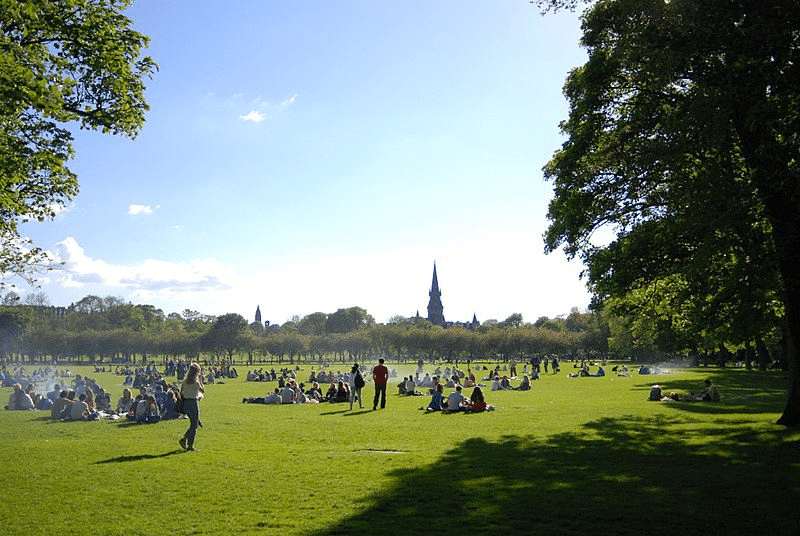
In conclusion, The Meadows is a place steeped in history. What began as a simple cattle pasture has gradually transformed into a cherished public park, embraced by locals as one of the city’s most iconic spots. Strolls and active recreation are now commonplace, and its numerous paths and avenues create a truly unique and delightful atmosphere, making it an indispensable part of Edinburgh’s fabric.