

In the mid-19th century, as humanity was just beginning to unlock the power of electricity, a boy was born in the Scottish city of Edinburgh who dreamt of making sound travel across distances. Alexander Bell grew up in a family that valued language, learning, and experimentation. His mother lost her hearing at a very early age, an event that profoundly influenced the future inventor. He strove to understand the technical aspects of sound, searching for a way to make communication accessible to everyone. More at edinburghname.
This article aims to explore Graham’s life journey, from his childhood experiments to his greatest discoveries. We will cover his youth and education, his work with deaf students, the invention of the telephone, and his other innovations—such as the photophone, aviation projects, and scientific experiments.
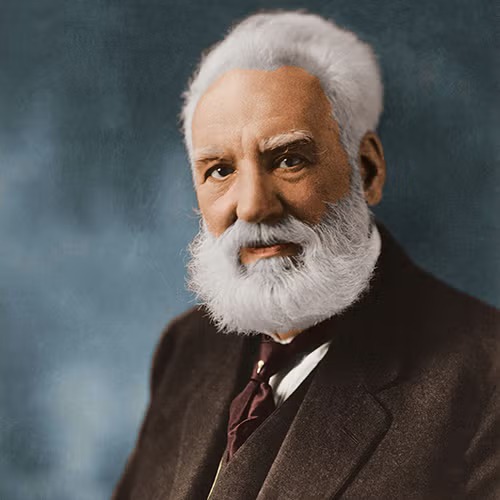
Origins
For young Alexander, the world was defined by sound and resonance from the very beginning. He was born and raised in Edinburgh, an intellectual centre buzzing with scholarly debate and artistic pursuits. But the true epicentre of his universe was his own home. The Bell family literally lived and breathed acoustics. His father, Alexander Melville Bell, was a prominent figure, a professor of elocution and a phonetician. He dedicated half his life to studying the mechanics of speech.
The boy’s mother, Eliza Grace Symonds Bell, was gradually losing her hearing. Slowly, reality transformed into a painful void, as a merciless wall of silence grew between him and one of the people closest to his heart.
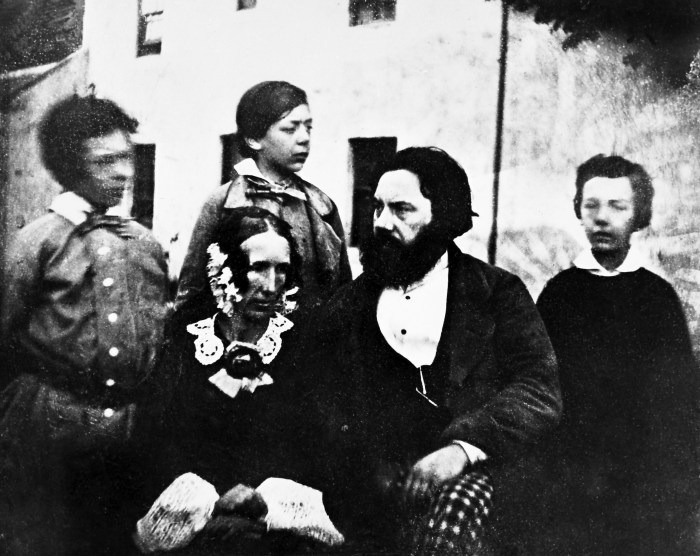
Against this backdrop, his formal education seemed dull. Although the young man attended the prestigious Royal High School, his mind had long since strayed beyond the curriculum. He left the institution at an early age, having no interest in the classical programme. His true learning took place at home, among the countless books in his father’s library.
Meeting Destiny
The year 1870 marked the beginning of a radical change for the Bell family: they left Scotland in search of a healthier climate, settling in the province of Ontario, Canada. The relative quiet of the Canadian province allowed Alexander to continue the family’s work, and he soon began a successful collaboration with the local community.
The very next year, his reputation as a renowned specialist in vocal physiology and methods for teaching people with hearing impairments led him to the United States. Boston welcomed the man from Edinburgh with open arms. This daily immersion in the mechanics of sound acted as a catalyst for something greater. Graham could not ignore the main technological challenge of the era: the telegraph. This technology could only transmit dry, intermittent signals. Bell, however, with his deep understanding of the very nature of sound waves, asked himself an incredibly ambitious question: could an electric current be made to vibrate in the same way air vibrates with the human voice?
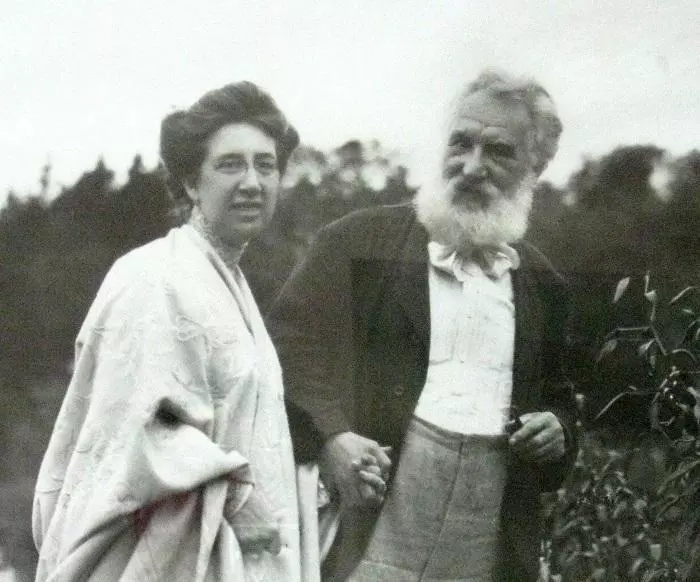
Achieving this goal required significant funding, and the search for it led him to influential patrons. Gardiner Hubbard, a talented lawyer, was prominent among them. But the decisive meeting was not with him, but with his daughter. Mabel had lost her hearing in early childhood and soon became one of Bell’s pupils. Her intelligence and inner strength immediately captivated the young inventor. They were married in 1877.
Sound at a Distance
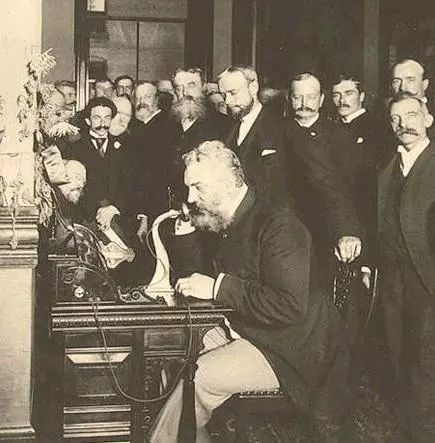
We previously mentioned the ‘Athens of the North’ native’s obsession with making an electric current reproduce the timbre of the human voice. This work culminated on 14 February 1876, when he filed a patent application with the US Patent Office for a “method and apparatus for transmitting vocal sounds telegraphically.” History almost took a different path, as only a few hours later, another innovator, Elisha Gray, filed a similar idea.
Fate was on his side: the patent was issued with astonishing speed on 7 March. Just three days later, his Boston laboratory was the scene of an incredible event. While working on an improved transmitter, Alexander spoke a phrase into the device, addressed to his assistant in another room: “Mr Watson—Come here—I want to see you.” Watson heard every single word.
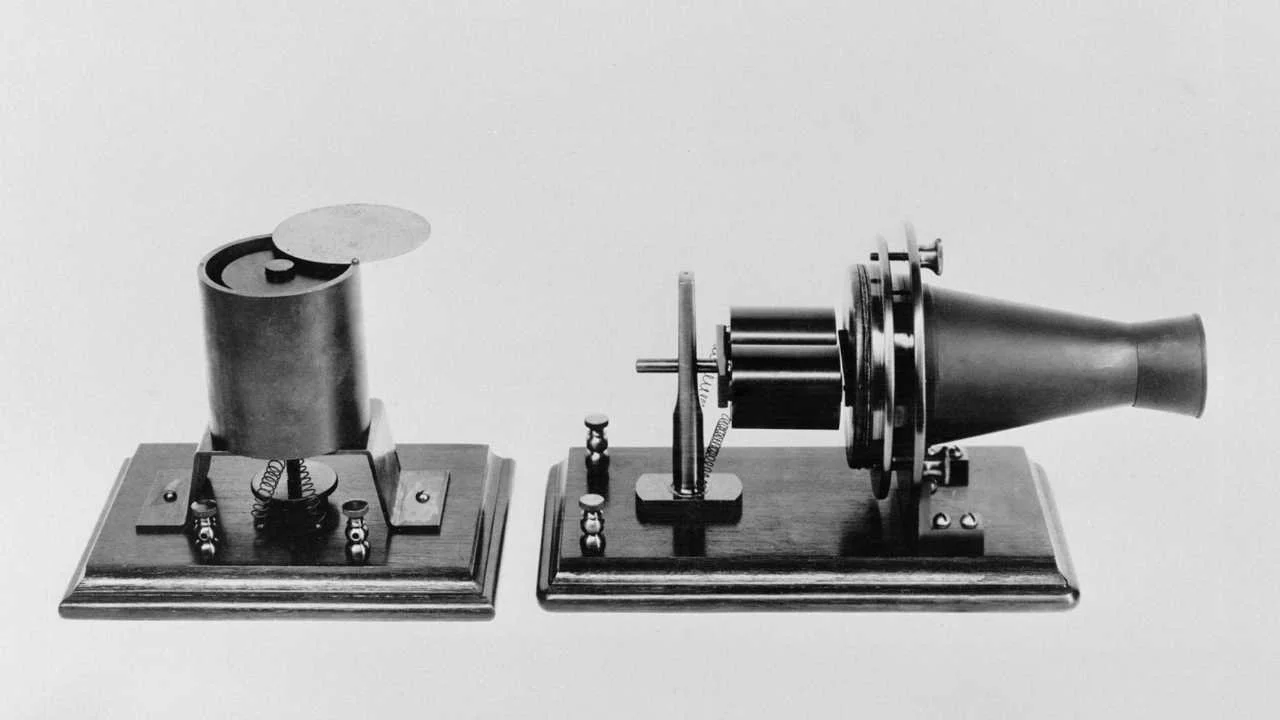
Everyone realised the potential of this invention, so Bell and his investors founded the Bell Telephone Company to commercialise the technology. The telephone era had officially begun. However, the inventor himself displayed a unique trait, one quite uncharacteristic of great innovators. The endless lawsuits and the routine of business tired him so much that his desire to become a ‘telephone magnate’ quickly faded. As soon as victory in the patent wars was secured, the Scotsman lost all commercial interest.
Further Discoveries
In 1880, after receiving the prestigious Volta Prize from the French government for his achievements in electrical science, he immediately invested the money to develop his natural calling. He established Washington’s innovation centre—the Volta Laboratory.
Key developments created under its roof:
- The Photophone: an invention that transmitted sound via beams of light. It was, in effect, the first attempt at wireless communication; a precursor to fibre-optic networks.
- The Graphophone. Working with his cousin Chichester Bell and engineer Charles Tainter, he set about improving Edison’s phonograph. Their version used much more practical wax cylinders instead of fragile tinfoil.
The Genius’s Final Haven
In the late 1880s, Graham sought respite from the bustle of the business world. He found the perfect place to rest on Cape Breton Island, Canada. There, near the village of Baddeck, he built a grand estate named ‘Beinn Bhreagh’ (Scottish Gaelic for ‘Beautiful Mountain’).
Captivated by the desire to fly, Alexander became passionate about aviation. In 1907, he even financed the ‘Aerial Experiment Association’ (AEA) – a group of young, talented engineers. Although his own experiments with giant tetrahedral kites were not successful, the AEA’s work helped lay the foundations for Canadian aviation.