

Park · Edinburgh · ⭐ 9.5/10 · 27141 reviews · updated: 2026-08-04 20:19:46
Address: Princes St., Edinburgh EH2 2HG, United Kingdom
Princes Street Gardens — a drained loch beneath the Castle Rock
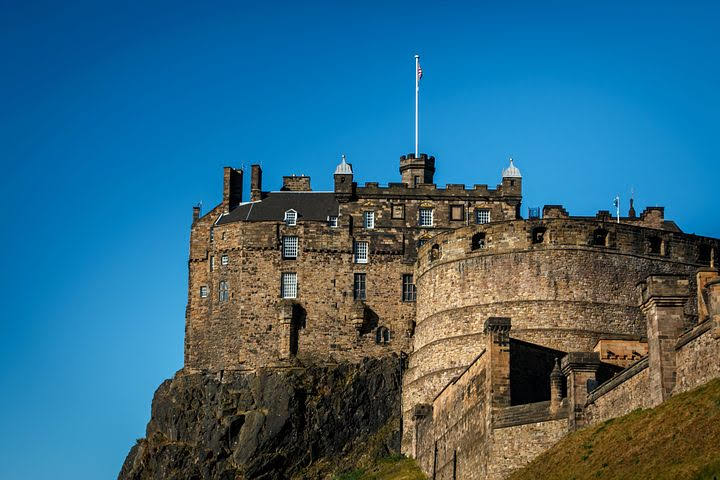
Few city parks have a stranger beginning. For three hundred years this ground lay under water: the Nor Loch, an artificial sheet dug as a defence along the northern flank of the Old Town, which slowly became the place where everything the tenements above wanted rid of ended up. Drain it, level it, plant it, and you get what is here now — a long green trough running below the Castle Rock, cut in two by a man-made ridge of earth, with the crowded silhouette of the Old Town rising on one side and the sober first-floor windows of the New Town looking down from the other. It is Edinburgh’s front garden, its concert bowl, its winter fairground and its most photographed stretch of grass, and it is a short flight of steps below one of the busiest shopping streets in Scotland.
Highlights
- The Ross Fountain — a tiered cast-iron extravagance of mermaids, walruses and a crowning female figure, gifted by the Edinburgh gunsmith Daniel Ross and erected in the West Gardens in 1872. It stood dry and corroding for years until a full restoration brought the water back in 2018, and it now lines up perfectly with the Castle for the city’s most repeated photograph.
- The Scott Monument — George Meikle Kemp’s Neo-Gothic spire, begun in 1840 and completed in 1844, rising 61.11 m above the East Gardens. A narrow spiral of 287 steps climbs to four viewing platforms, and the stonework carries dozens of characters from Sir Walter Scott’s novels and poems.
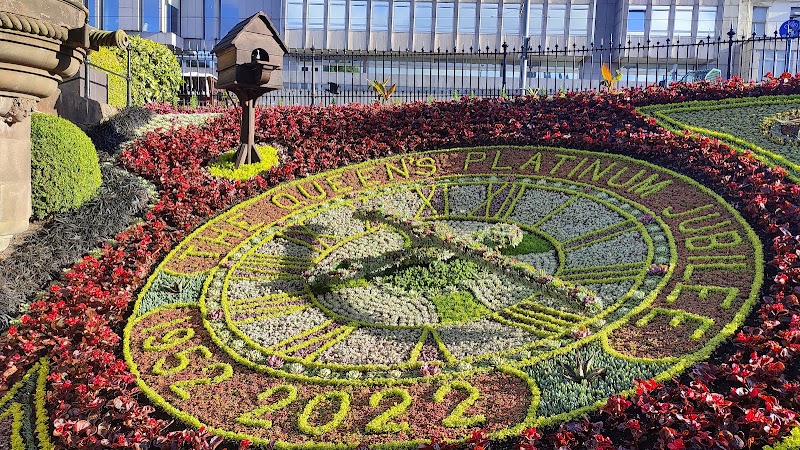
- The Floral Clock — the first working floral clock in the world, laid out in 1903 by parks superintendent John McHattie with the mechanism supplied by Edinburgh clockmakers James Ritchie & Son. It had only an hour hand in its first season; a minute hand followed in 1904. It is replanted every year to a fresh commemorative theme using tens of thousands of small bedding plants.
- The Ross Bandstand — the amphitheatre at the heart of the West Gardens. The first bandstand here was a gift of 1877 from William Henry Ross, chairman of the Distillers Company; the structure standing today dates from 1935 and remains the stage for the Hogmanay Concert in the Gardens.
- The war memorials — the Royal Scots Greys Memorial with its bronze cavalryman, the Scottish American War Memorial with its seated kilted soldier, the Royal Scots Monument designed by Sir Frank Mears with sculpture by Pilkington Jackson and unveiled in 1950, and the Norwegian Brigade stone left by soldiers who trained in Scotland during the Second World War.
- Wojtek the Bear — a bronze of the Syrian brown bear adopted by Polish soldiers, who carried ammunition at Monte Cassino and ended his life in Edinburgh Zoo. The sculpture was unveiled in the West Gardens in 2015 and has become an unofficial memorial to the Polish presence in Scotland.
What you’ll find
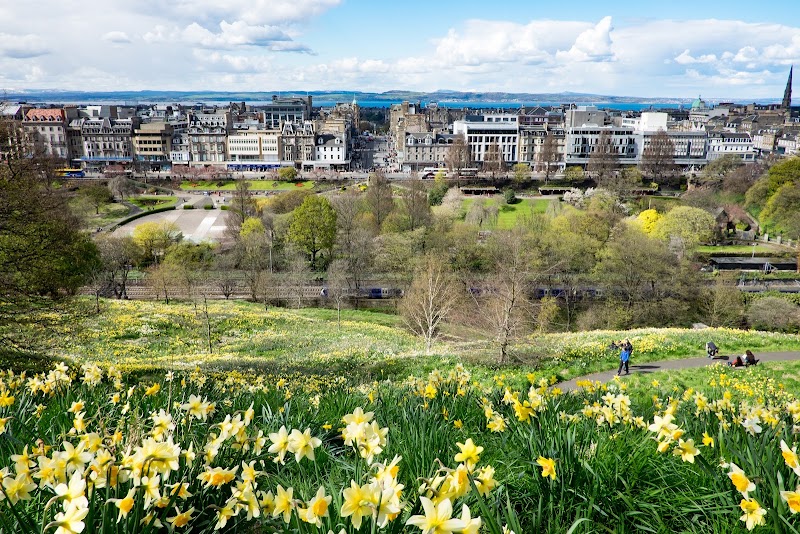
The park is really two parks with different characters, separated by the earthen ridge raised out of spoil from the digging of the New Town. East Princes Street Gardens covers about 8.5 acres (3.4 ha) and is the busier, flatter, more formal half, running to the railway station. West Princes Street Gardens is far larger at roughly 29 acres (12 ha), with steep grassy banks, mature specimen trees and long benches facing the Castle.
- Broad lawns used as the city’s default picnic ground the moment the sun appears, with sloping banks that work as natural seating for the bandstand.
- Formal bedding, herbaceous borders and a collection of mature trees, some planted in the Victorian layout of the 1870s and 1880s.
- A dense population of statues — David Livingstone, Adam Black and John Wilson in the East Gardens; Allan Ramsay, Thomas Guthrie and the pioneer of chloroform anaesthesia James Young Simpson in the West.
- The Gardener’s Cottage, built in 1876 to a design by the City Architect Robert Morham, now serving refreshments at the east end of the West Gardens.
- A working railway running in a cutting along the southern edge, driven through in 1846 by the Edinburgh and Glasgow Railway and disappearing into tunnels at both ends.
- Curiosities most visitors walk past: the Mortonhall Baby Ashes Memorial dedicated on 2 February 2019, and the flat-roofed wartime shelters of 1939 and 1950 built into the banks.
Things to do — and who it’s for
- First-time visitors — the single best vantage point on the Castle Rock, reached without a ticket, a queue or a climb; half an hour here explains the geography of Edinburgh better than any map.
- Photographers — the Ross Fountain with the Castle behind it in late afternoon light, and the Scott Monument silhouetted against the sky from the lower paths at dusk.
- Families with small children — flat, enclosed, easy to supervise, with cafés, toilets and a rescue plan in every direction if the weather turns.
- Office workers and students — a genuine lunchtime park in the middle of the commercial city, with grass banks that dry quickly and benches facing south.
- Concert and festival goers — the bandstand bowl holds a serious crowd, and the Gardens are the venue for the Hogmanay concert and much of the city’s outdoor winter programme.
- Anyone with limited time — a compact walk that strings together a national monument, the world’s first floral clock, a restored Victorian fountain and half a dozen war memorials in under an hour.
Getting there & practical
The Gardens sit in the very centre of the city, in the trench between the Old Town and the New Town, and no visitor needs to plan a journey to them — you arrive at them by accident. Waverley station stands immediately at the east end of the East Gardens; Haymarket is about fifteen minutes’ walk to the west. Edinburgh Trams call at the stops named Princes Street, St Andrew Square and West End – Princes Street, all of which put you at a garden gate. A very large share of the Lothian bus network passes along the north side, including services 4, 25, 26, 31, 33 and 44, and city-centre works occasionally alter stopping patterns, so it is worth checking before you travel. Entry is free and always has been in modern times. Gates open in the morning and close around dusk, which in a Scottish winter can mean mid-afternoon and in June means close to ten at night; the East Gardens close earlier and partially during the winter festival build. Allow forty minutes for a brisk walk through, two hours or more if you climb the Scott Monument, and rather longer if the sun is out and you have brought food.
When to visit
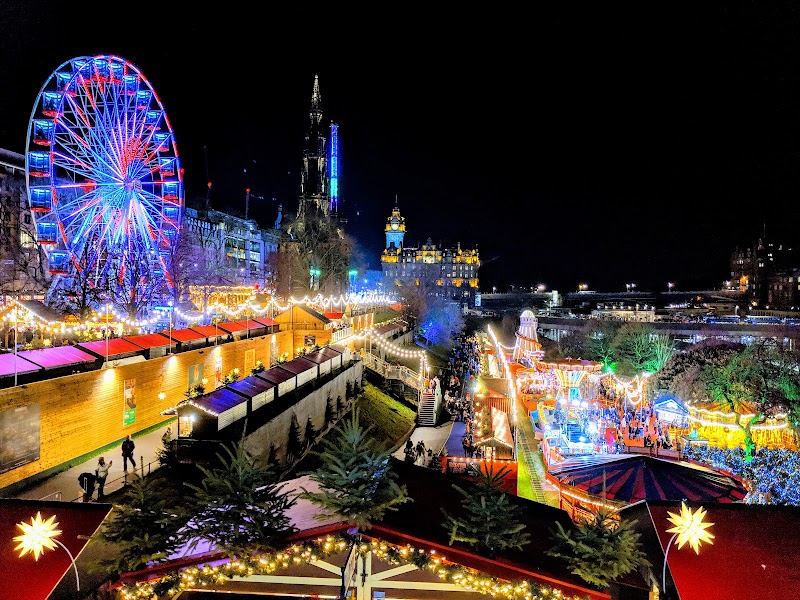
Spring is the park’s showiest season: crocus and daffodil sheets on the banks below the Castle from late February, cherry and magnolia in April, and the Floral Clock replanted and started up for the year in the early summer. Summer turns the lawns into the city’s living room, and August brings the Festival and the Fringe, when the Gardens become the place performers, audiences and exhausted locals collapse between shows — the crowds are considerable but the space absorbs them. Autumn is the quiet reward: the mature trees in the West Gardens colour beautifully, the low sun rakes across the Castle Rock, and the paths are suddenly your own. Winter splits in two. From mid-November until early January the East Gardens are given over to Edinburgh’s Christmas, with the market, big wheel and rides lit up beneath the Castle, while on 31 December the Ross Bandstand hosts the Concert in the Gardens and the fireworks go up over the Rock at midnight for Hogmanay. Come in the first half of January and you get the rarest version of all: an empty, frosted, silent park in the middle of a capital city.
Good to know
The Nor Loch was not a natural feature. It was created as a defensive water barrier on the north side of the Old Town during the medieval period, and by the eighteenth century it was a byword for filth, fed by drains from the ridge above. Draining began in the 1760s as the New Town was laid out to the north, and the ground was gradually reclaimed and planted, with the gardens taking recognisable shape by around 1825. For much of the nineteenth century the western half was not public at all: control passed to a body of Princes Street Proprietors in 1816, and from 1821 the gardens were open only to key-holding subscribers from the surrounding houses. The town council bought the ground back for the public in 1876, over the loud objections of residents who had grown used to a private view. The railway arrived first, in 1846, when the Edinburgh and Glasgow Railway drove a cutting along the southern edge together with the 910 m Haymarket Tunnel and a shorter bore beneath the ridge — the reason trains still emerge and vanish beside the flowerbeds. The monuments accumulated steadily: the Scott Monument in 1844, the Ross Fountain in 1872, the Gardener’s Cottage in 1876, the Floral Clock in 1903, the current bandstand in 1935, the Royal Scots Monument completed in 1950 and finalised in 2007. Even the Second World War left its layer — four large air-raid shelters were built in 1939, and a distinctive set of shelters along the upper walkway followed in 1950 to a design by Alexander Garden Forgie.
Visitor tips
- Approach the Ross Fountain from the western end rather than from the steps: the fountain, the Castle and the crags line up on that axis, and the light is best in the late afternoon.
- The lower paths in the West Gardens are noticeably sheltered from the wind that funnels along the ridge above — a real difference on a raw day, and the reason the benches there fill first.
- During the winter festival the East Gardens are fenced and ticketed in parts; if you want the classic empty view of the Castle in December, walk the West Gardens instead.
Questions & answers
Is there any charge to enter Princes Street Gardens? No. The Gardens are a free public park in both halves. Charges apply only to specific attractions inside them — climbing the Scott Monument, and the rides and market of the winter festival in the East Gardens.
Why is the park in a valley? Because it is a drained loch bed. The Nor Loch filled the hollow between the Castle Rock and the ground to the north until drainage in the second half of the eighteenth century; the level trough you walk along is the old lake floor.
What is the difference between the East and West Gardens? East Princes Street Gardens is the smaller half, about 8.5 acres, running to the railway station and dominated by the Scott Monument; it hosts the Christmas market. West Princes Street Gardens is around 29 acres, hillier and greener, and contains the Ross Fountain, the Floral Clock and the Ross Bandstand.
Can you climb the Scott Monument? Yes. A spiral stair of 287 steps leads to four platforms, the highest of which gives a rooftop-level view along the New Town and across to the Castle. The staircase is narrow and not suitable for anyone uncomfortable in tight spaces; a ticket is required.
Is the Floral Clock really the world’s first? Yes — it was created in 1903 and is recognised as the first working floral clock anywhere. It began with an hour hand alone, gained a minute hand in 1904, and is now replanted every year with a new design.
When is the Christmas market on? Edinburgh’s Christmas typically runs in East Princes Street Gardens from the middle of November until the first days of January, with a market, a big wheel and fairground rides. Dates and layouts shift a little each year, so check the current programme before travelling specifically for it.
Are dogs allowed? Yes, the Gardens are a normal city park for dog walkers, though dogs should be kept under close control on the busy central paths and around the monuments, and event areas may be fenced off during the festival season.
How long should I allow? Thirty to forty minutes to walk through and see the main monuments; around two hours if you add the Scott Monument climb and a coffee; a whole afternoon in summer, when the banks below the Castle are one of the pleasantest places to sit in Britain.
Photos
Show 1 more photos
Visitor reviews
Reviews last updated: 2026-08-04 20:19:46
Data is refreshed monthly. Sources: edinburghname.com and editorial picks based on reviews.
Incredible views, walking here is a real pleasure
A wonderful place in the city centre for relaxing, a picnic, a walk, socialising, photo shoots. Beautiful at any time of year — in spring and summer there are beautiful flowers, in winter the Christmas market and the fun…
A historic place with a lovely view.